Thoughts on “Thinking Like a Mountain”

Thinking Like a MountainRecently, while comparing educational pursuits with another returning college student who is seeking teaching licensure in literature, I conveyed my aspirations of redirecting my career in the outdoors and environmental industry beyond a Bachelor of Fine Arts degree in Creative and Professional Writing and a Bachelor of Science degree in History at Bemidji State University.  Aspirations that include pursuing a writing and educating career in some aspect of the outdoors and environment in order to fulfill my personal ambition to “leave something behind” when I am no longer a physical presence in this world, something to show that I have done my part to contribute to the betterment of society.

By this, the co-ed asked if my inspirations included Aldo Leopold.  Embarrassed to admit that I was only slightly familiar with the name and what it stood for, not the man and his work, I deflected his inquisition to what my experience included, the work I was doing now, and where I hoped that would lead me.

A recent reading assignment of the essay “Thinking Like a Mountain” by Aldo Leopold for my People and the Environment course provided the opportunity to research and the life long work of Aldo Leopold, the forester, ecologist, conservationist, environmentalist, philosopher, educator, writer, fisherman, hunter, and outdoor enthusiast.

Leopold is considered by many to be the father of wildlife management and of the United States’ wilderness system.  His life’s work was influential in the development of modern environmental ethics and in the movement for wilderness preservation.  His introduction at The Aldo Leopold Foundation website begins with this quote:

“As a society, we are just now beginning to realize the depth of Leopold’s work and thinking.”

– Mike Dombeck, Chief Emeritus U.S. Forest Service, Professor of Global Environmental Management UW-Stevens Point, UW System Fellow of Global Conservation

In Leopold’s greatest written work, and the culmination of his life’s work, A Sand County Almanac, completed just prior to his death in 1948 and published postmortem, he wrote “The Land Ethic”, a chapter where he lays out his conservation plan for the human culture.  Under the Community Concept of this land ethic, Leopold wrote:

The land ethic simply enlarges the boundaries of the community to include soils, waters, plants, and animals, or collectively: the land.

…a land ethic changes the role of Homo sapiens from conqueror of the land-community to plain member and citizen of it. It implies respect for his fellow-members, and also respect for the community as such.

In “Thinking Like a Mountain,” we are offered a view of a precursor to Leopold’s land ethic.  A profound moment in his life when he realizes the value of a community that includes the land, and the tragic consequences that occur when any component of that community is severed, lost, or no longer permitted to exist. 

Leopold demonstrates through his own experience the recognition of changing mindset.  The wolf as a member of the land, the natural world, must persist for the good of the overall quality of life on this planet.  The example of his killing the wolf and ultimately his realization of what has become of the wilderness without it shares the knowledge learned through the act of recklessness and disregard for the delicate balance in the ecosystem.

In short, he is warning society not to duplicate this reckless disregard on a global scale.  Our culture owes an ethical responsibility to the place that gives us life.

Ditches

DitchesDo you think counties should be spending money on mowing ditches?

I found the following detail of the Minnesota statute pertaining to mowing ditches at the Minnesota State Legislature website, or more specifically at the Minnesota Office of the Revisor of Statutes website:

2007 Minnesota Statutes

  • 160.232 MOWING DITCHES OUTSIDE CITIES.
    (a) To provide enhanced roadside habitat for nesting birds and other small wildlife, road
    authorities may not mow or till the right-of-way of a highway located outside of a home rule
    charter or statutory city except as allowed in this section and section 160.23.
    (b) On any highway, the first eight feet away from the road surface, or shoulder if one
    exists, may be mowed at any time.
    (c) An entire right-of-way may be mowed after July 31. From August 31 to the following
    July 31, the entire right-of-way may only be mowed if necessary for safety reasons, but may not
    be mowed to a height of less than 12 inches.
    (d) A right-of-way may be mowed as necessary to maintain sight distance for safety and
    may be mowed at other times under rules of the commissioner, or by ordinance of a local road
    authority not conflicting with the rules of the commissioner.
    (e) A right-of-way may be mowed, burned, or tilled to prepare the right-of-way for the
    establishment of permanent vegetative cover or for prairie vegetation management.
    (f) When feasible, road authorities are encouraged to utilize low maintenance, native
    vegetation that reduces the need to mow, provides wildlife habitat, and maintains public safety.
    (g) The commissioner of natural resources shall cooperate with the commissioner of
    transportation to provide enhanced roadside habitat for nesting birds and other small wildlife.

I agreed with most of this Minnesota statute, then I found the information at the Office of Environmental Services website for the Integrated Roadside Vegetation Management (IRVM) process

IRVM is a decision-making and quality management process for maintaining roadside vegetation that integrated the following:

  • the needs of local communities and highway users
  • the knowledge of plant ecology and natural processes
  • design, construction, and maintenance considerations
  • monitoring and evaluation procedures
  • government statutes and regulations
  • technology

…with cultural, biological, mechanical, and chemical pest control methods to economically manage roadsides for safety plus environmental and visual quality (NVRMA, 1997).

First of all, you can be sure that county ditch mowers run wild during the month of August if not before that every year in this state.  It happens nearly every year across the front of my property; every once in a while my ditch, the one you see pictured above, eludes the razor’s edge.  If a ditch being mowed would resolve a safety issue I could understand that, but I believe in most cases it falls on those last two words in the IRVM statement…

“visual quality.”

Mother Culture has beaten into our minds that a freshly mowed expanse of grass is the only acceptable form of appearance for that piece of real estate, which in fact, by the statutes own words is habitat for wildlife and native vegetation.  What’s wrong with the wildflowers that bloom in my ditch each summer and the beauty of the grasses waving in the wind?  Isn’t that “visual quality?”

Then there is the mention of “chemical pest control methods.”  Are these really necessary?  Where do those chemicals end up?  In the water supply?  In the lakes I fish?  Not to mention the fuel consumption and emissions produced just to maintain this unjustified taxpayer expense of visual quality.

Wouldn’t the first eight feet mentioned in the statute, if that is even necessary, be enough to solve the safety issue at all times?  Don’t come around here mowing my ditch.  We don’t need your habitat destruction in the guise of management.  There’s already plenty of it going on in this world.

Live and Let Live

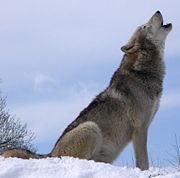
Howling WolfDo you think humans should decide whether or not another species lives or dies?

I would think that the answer to this question to be an obvious no.  That is, if we are talking about simply, as if this could be a simple discussion, the existence of a species, period.  If a species were to fade into extinction, it should only be at the hands of an evolutionary demise.  I believe all humans have some basic type of understanding about the importance of each individual species’ role in its habitat or environment, our environment.

Should we knowingly disregard the extermination of any species at the hands of human society?  NO

Should we continue to study the effects of human society on the global environment to prevent any species’ extinction, and work to aid the recovery of any endangered species?  YES

However, the slant of this discussion where the line blurs and the black and white blends to gray is the debate that ensues when a species is no longer a welcome inhabitant of a geographical space, or is perceived to be an alien intruder in that space.

The reality is civilization’s encroachment on the unique habitats throughout the world causes the confrontation between humans and the most visible threatened species; the large mammals, birds, fish, reptiles, and trees.  It is a debate that began with the advent of the agricultural age, when human proliferation began to threaten the surrounding and coexisting species.  Whether directly affected by the urbanization caused by the rampant, relatively recent, explosion in the human population, or disrupted by the blatant misuse or mistreatment of our natural resources by the increasing agricultural and economical demands imposed on our natural capital, the first and biggest losers will always most likely be the species that require the most space in comparison to our own demands.  In competition with the human species, they don’t stand a chance.

But what about the invasive species of the world’s unique habitats?  Are these species invasive because we deem them to be a threat to the invaded ecosystem and our way of life, or is it part of the evolutionary cycle?  Certainly Eurasian watermilfoil, sea lamprey, zebra mussels, and Asian carp for example are negative influences to the delicate balance in the ecosystems of Minnesota’s lakes and rivers.  But I would argue that, while undesirable, these intruders still deserve the right to coexist with humans because of their intrinsic, and possibly yet to be discovered, value.

Also, there is this question, are we the invaders in every ecosystem on the planet?

Check out the following sites to learn more about invasive species: