My Ecological Footprint

After retaking the quiz to determine my personal footprint using the ecological footprint calculator on the Global Footprint Network website, there is still an obvious need for me to change my ecological footprint.  I took another run through the quiz because after receiving a score of needing 10.3 planet Earths “if everyone lived like me” on the Basic Information version of the quiz, I felt that there were many aspects of my lifestyle I could not express in that basic form.  Thus, the basic format did not make considerations for certain distinctions which would more accurately define my footprint, such as the fact that I rarely buy meat or fish from a grocery store.

Almost all of the meat and fish I prepare at home are a product of my personal hunting and fishing harvests.  These are wild animals that are not costing the Earth in the usual, and more expensive, way a farm raised animal would.  Yes, I do expend fossil fuel in pursuing them and I do puchase goods that are the tools for my harvest, but there is no way wild game costs the Earth as much natural capital as farm raised animals  

Retaking the quiz in the Detailed Information format made an enormous difference in my footprint.  The detailed format brought my ecological footprint down to the need for 4.4 planet Earths “if everyone lived like me.”  According to this figure, it requires 19.7 acres of the Earth’s productive area to support my lifestyle.  I still have some reservations about not being able to go even more in depth with the way I feel I work to conserve and preserve our natural capital, and with the assumptions that are made because of the country in which I live.  I agree that America is a throw-away society, but, like in all aspects of society, it is not fair to stereotype by nationality.  Also, the fact that my footprint jumps from 10.3 to 4.4 between the two versions of the quiz makes me hesitate some as well about the accuracy of the final tally.

However, for the simplicity of the quiz, I realize some assumptions must be made.  That being said, there are still changes I need to make to improve my ecological footprint, obviously, because we don’t have 4.4 planet Earths – we have one.  If I want this one planet to be a livable place for my children’s children and grandchildren, then I need to adjust my worldview from a mix of planetary management and stewardship to at least a mix of stewardship and environmental wisdom if not making a total lifestyle commitment to environmental wisdom is not possible.

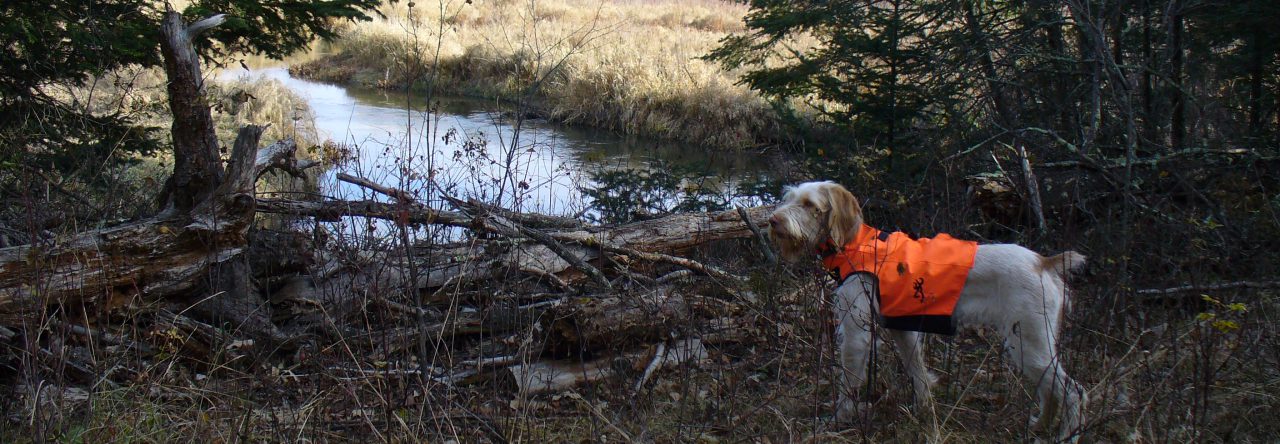
I can make changes to certain aspects of my lifestyle that will benefit my footprint, such as purchasing more organic foods.  I like my toys and gadgets, but I have subdued my obsession with these things.  When the urge arises in the future, the better option would be to buy used.  I am already a diligent recycler inside and out of the home, but there is still much more I can do to reduce the amount of unnecessary waste and the amount of natural capital that is necessary to produce, dispose, or recycle it.  I can use less fossil fuels in my home and on the road by using my mountain bike for the commute, keeping an even closer eye on my energy saving thermostat, reducing the amount of time energy spent manicuring a park like acreage and allowing the growth of more native plants, and substituting the motorcycle for the truck on longer journeys – now if I only had a sidecar for the dog!  I draw the line at my house though – because I like it.  I won’t trade it in to pitch a tent somewhere just because the dog and I are the only ones using this space.  I am making the effort to consolidate more individuals under the same roof however, so I guess that is a work in progress.

Hobson Forest

Hobson ForestOur field trip to Hobson Memorial Forest on Thursday offered a chance to spend part of the morning in nature’s classroom.  Prior to the field trip, I didn’t know that BSU owned a piece of the forest, so it goes without saying that I had never been there.  But any day in the woods is a good day.

After a short drive to the forest northeast of Lake Bemidji and a short hike through the rustic log cabins area on our way to the amphitheater for a quick briefing, we were turned loose to explore in solitude.  Leaving the amphitheater area, I anxiously looked for a way to separate myself from the group and an alternate exit down a game trail helped me slip out of sight within seconds of departure.  We had a half hour.  I didn’t have a watch.  There would be a whistle when time was up.  I was soon out of whistle range.  Now, what natural wonders could I find?

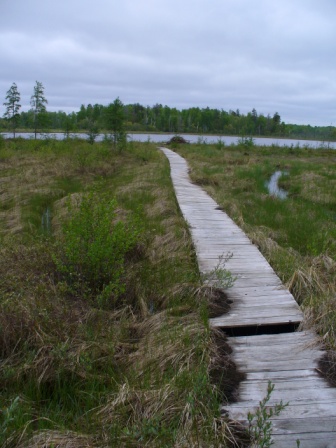
Before I could escape deeper into A Beaver Boardwalkthe woods, the ridge trail I followed dropped into a clearing where a boardwalk snaked through a bog leading to a beaver lodge.  It looked as though the beavers could have designed its route themselves – easy access to the shoreline timber, but a long drag back.  I didn’t dare pay a visit; I was unannounced and the first few steps down the boardwalk looked precarious at best. 

Back up the ridge, I came across a deer enclosure where university scientists study the affects of the white-tail herd outside the enclosure versus the protected vegetation inside the enclosure.   Time to get off the game trail, and deeper into the woods.  I cut cross-country between the ridge and swamp.  Weaving through deadfalls and blowdowns in the soft soil just above the water table, I came across a favorite perch of a resident squirrel where winds had found the breaking point of an immature oak.  No chatter of discontent with my presence, but it left behind part of its cache for later, or for better feasting elsewhere.

Squirrel LeftoversWorking away from the water and into the woods, I interrupted two male American Redstarts squabbling over something so intensely that their game of give and chase brought their course within inches of me.  In fact, I had to side-step them as they dove through the underbrush.  A second later, I gathered myself and my camera to capture brilliant black and blaze woods warblers, but they called a cease to their dispute to elude their intruder.

I must have hit some tall grass somewhere because a half dozen wood ticks were making their way north along my legs looking for a warm spot to engorge with indulgence. 

The forest, bursting with growth from a late spring of blanketing snow and soaking rains, created such a fluorescent green, I strained to remember the last time I had seen as rich a color.  Tiny pops of lavender and red were revealed along the way deeper into the woods.  The whole place Wildflowerssmelled washed clean by the rains the day before.  The rains had also left the forest floor damp, soft, and quiet, perfect hiking conditions for discovering something with the element of surprise.

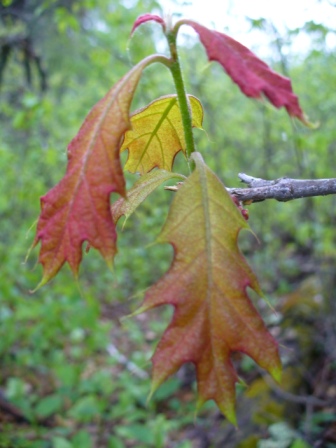
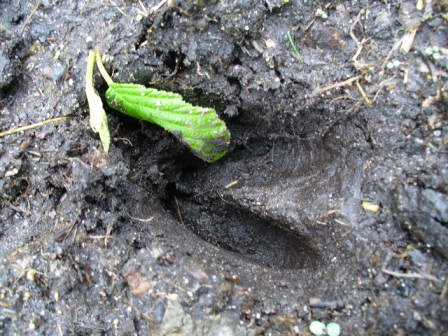
Deeper into the older growth trees and thicker underbrush I lost the cool breeze of the morning and waves of mosquitoes began to sing into my ears.  I’ll cross one more ridge and then I’ll turn back, or maybe the next ridge after that.  I don’t want to turn back.  I have to have been gone for a half hour, but I’ve only just begun to explore this place.  To turn back now would be anticlimactic.  I didn’t have enough time to even begin to map things out in my head.  But fresh white-tail tracks told me it was Burst of Redtime I make tracks myself before someone sends a search party.

I picked up another class member along my way back who had neglected any recognition of a watch as well.  Together, we rendezvoused with one of the instructors who was on his way back from looking for stragglers at the amphitheater.  I never heard a whistle.  We were the last ones back.  Nearly left behind.  I took only photographs, and left only footprints, as the saying goes, but my senses were still computing all the information they had just received.

I wonder what was over that next ridge?Fresh Tracks


Campus Environmental Tour

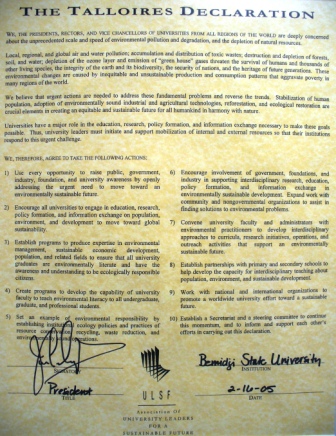
Talloires DeclarationOn Tuesday we took a little stroll around campus discussing some of the ways Bemidji State University demonstrates its responsibility as an institution for higher education by creating an educational environment that pledges to work towards sustainability.  As a public educational institution producing tomorrow’s leaders, the university needs to set an example for the generations of the current and future environmental stewards it prepares for graduation into society.  If our society is to change its practice of mismanagement of our natural capital, we have to learn how to change.  By establishing educational resources for the study of how we can successfully become a sustainable society, Bemidji State University joins a commitment to environmentalism with other leading institutions and organizations working to provide a healthier future for our local and global ecosystem.  The president of the university, Dr. Jon Quistgaard, promises this obligation by uniting with over 350 university presidents and chancellors in over 40 countries around the world in the Association of University Leaders for a Sustainable Future through the Talloires Declaration, and the university community expects a proposal to further this promise with a future signing of the American College & University Presidents Climate Commitment.

Other examples of Bemidji State University’s commitment to an ecocentric environmental worldview are detailed in these press releases from the university on November 29, 2007:

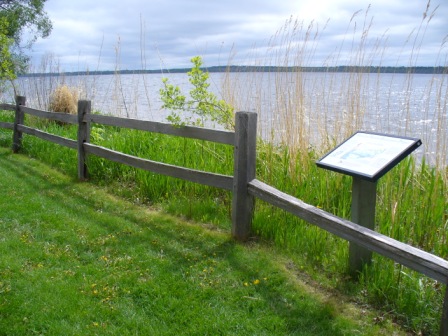
Other campus projects I find to be equally important, if not on the same scale as the above mentioned movements of environmentalism, then on the measure of what can be done by the individual or small group to renew and improve our campus and community are:BSU Campus Shoreline Habitat Restoration Project on Lake Bemidji

  • The Shoreline Habitat Restoration Project performs the following benefits for our local ecosystem and our downstream neighbors:
    • Restores a buffer zone using native plants
    • Provide habitat for a wide variety of wildlife
    • Filter out pollutants and runoff that degrade water quality
    • Prevent shoreline erosion by absorbing wave action
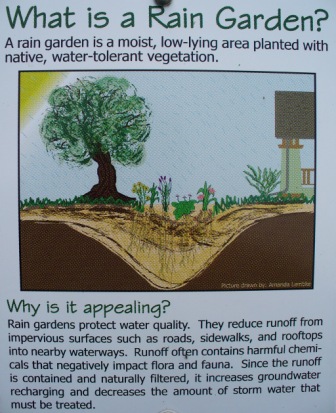
  • The implementation of a Rain Garden to reduce runoff and naturally filter storm water.

What is a Rain GardenA BSU Rain Garden

  • Landscaping with Native Plants such as a Butterfly Garden provide multiple benefits:
    • Native plants have evolved and adapted to local conditions over thousands of years.  Once established, they require no irrigation or fertilization.  They are resistant to most pests and diseases, and require no mowing.  Thus, native plants, conserving water and fossil fuels, and requiring less work to maintain, are less costly in the long term.
    • Native plants have longer root systems than non-native species which helps rainfall percolate into the soil, reducing erosion and runoff, and recharging ground water and improving water quality.
    • Native plants provide food and shelter for birds, butterflies and other desirable wildlife.

BSU Butterfly GardenThis little tour around campus inspired me to begin planning some improvements to my own property’s landscape.  I have always favored native plants for their simplistic beauty and minimal maintenance.  I especially have affinity for trees.  After discussing the question of why we mow and manicure our lawn with Professor Bailey-Johnson when a thoughtfully landscaped native plant ecosystem provides habitat for beneficial species, such as dragonflies – which prefer longer grasses while mosquitoes do not and dragonflies eat mosquitoes, I would rather have more habitat and wildlife on my property than an aesthetically pleasing keeping-up-with-the-Jones’-look.  Also, there is the consideration of time spent mowing – three hours per tour for me, but I have plans to cut that in half – and the incredible fact that 5% of all emissions in this country come from lawnmowers.  I mean really – why?