The Wall That Heals

Last week the Traveling Vietnam Veterans Memorial spent a few days in Bemidji.  I didn’t know it was scheduled to be here.  On my way home from class last Thursday, I was driving by the Lake Bemidji waterfront and, as I was looking at the melting snow and ice on the lake, when my attention became fixed on the Memorial.  I had to stop.  I turned around at the next set of lights and pulled in to the Bemidji Tourist Information Center at the waterfront.  I wasn’t sure what to expect.  I have never been to our nation’s capitol, though it is on my list, but I have often wondered about the power of the Vietnam Veterans Memorial.

I didn’t have my camera with me so my first stop was at the information booth to inquire how long the replica would be here.  There is an information trailer which carries the walls from city to town across America and houses displays of memorabilia from the war and era.  The Wall That Heals is comprised of two walls approximately 123 feet long.  The walls meet at an angle of 121 degrees and rise to a height of approximately 5 feet at the vertex.  It is a half-scale replica – exact to the letter and inch – of the original Vietnam Veterans Memorial in Washington, D.C.  The memorial holds 58,000 names.

As I waited in line, several people in front of me were inquiring as to the locations of names of loved ones, friends, acquaintenances.  Inside the trailer, veterans punched up the names on computer screens.   I watched as lists of names popped up until the search was narrowed to one or two.  I didn’t have a name to ask about.  A fact that was calming and troubling at the same time.  I’m not sure I can explain why.  Perhaps, it was just knowing the sacrifice all these individuals and their families made.  Perhaps it was a guilt for not having shared that same sacrifice.  Perhaps it was pride and thankfulness for those who chose to stand up for freedom and everything the greatest country in the world symbolizes.  Perhaps it was just being in the presence of the memorial, a symbol of the price of freedom.

After getting my answer about how long it would be staying here in our town, I made my way over to the wall.  Although I did not have a particular person to thank, I needed to pay my respect.  I started at the vertex and made my way down both wings of the wall.  The list of names begins at the vertex of the walls below the year of the first casualty, and continues to the end of that wing.  It resumes at the beginning of the opposite wing, ending at the vertex, above the date of the last death.  This meeting of beginning and ending signifies an epoch in American society.

As I approached, the older lady who was in line in front of me at the information booth had just found the name she was in search of.  She touched it, and touched it again, then stepped back and put her head in her hands.  To her right there were flowers left by some unknown visitor for one, or maybe more, in the list of names.  A few feet farther and one veteran was taking the picture of another veteran pointing to a third veteran, who appeared on the wall.  My eyes scanned a path through the list and stopped briefly at familiar last names.  “I am terrible with names,” I thought to myself.  Then I overheard a woman pointing out to one of the veterans assisting with the exhibit that an older gentleman was seeming to be having a difficult time near the far end of the left wing.  I did not hear the veteran’s reply, but I got the feeling he was already well aware of the older man.  I looked ahead of me to catch a glimpse of this gentleman.  With a cane that lay beside him, he was crouched on one knee.  His arm was outstretched to brace him against the wall, and his head held tightly against his arm.  His long hair shielded me from his face that, I could only conclude, was filled with unimaginable sorrow.

I had not been there that long, but the emotion I was feeling was overwhelming.  When I got home, I called family members to see if we knew any of the names on the memorial.  I was feeling compelled to locate a link to the wall for myself.  But the answers were all blank.

I planned to return to the replica later in the weekend to take pictures of this experience, but the snows of April changed my plans and I never returned.  Perhaps it is better that way.  Perhaps I shouldn’t take any more from a wall that has already given so much to me.  I write in these essays you see on this screen about the freedoms and liberties the men and women behind the names on the memorial fought to protect.  I am forever thankful for that.  I am forever thankful to every veteran who ever defended the greatest country in the world.

A Living Monument

Josiah A. King and his three-man crewRecently I was finally able to visit a place that I had only heard about since moving here to Bemidji.  A place where towering giants live.  A place where majestic white and red pines have been spared the lumberjack’s ax and saw to become an old growth sanctuary.  This place is the Lost Forty.

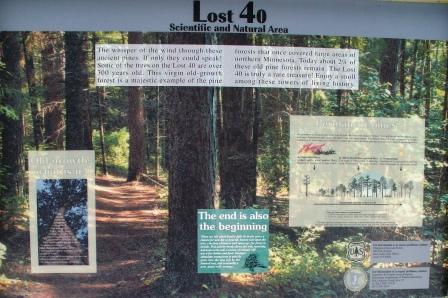
It takes a little doing to get there as the name of this place would suggest.  Not exactly on the main route today, one can only imagine what the territory looked like 125 years ago.  A survey crew’s error in 1882 mapped the Lost Forty, which is actually 144 acres, as being underwater in nearby Coddington Lake.  Surveyor Josiah A. King and his three-Lost 40man crew had traveled over 40 miles from the nearest white settlement of Grand Rapids for the project of finishing one of the first land surveys of Northern Minnesota.  For a month, in the unsettling winds of November the survey team lived in canvas tents and on rations of flour, pork, beans, and dried apples.  An error at the time has created a testament to our North Woods heritage.

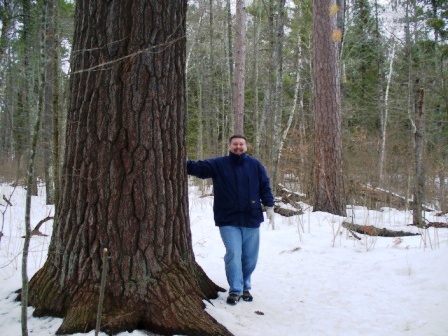
Today, with only two percent of Minnesota’s forested land considered to be old growth, this stand of virgin pine has Monster white and red pinesbecome a monument within the Chippewa National Forest.  These magnificent trees are between 300 and 400 years old.  That’s well over 100 years older than this great country itself, dating back to the 17th century and the first colonial settlements.  Many of the behemoths are up to 350 years old and are just now reaching retirement age as compared to our life span.  White and red pines can live to about 500 years old.  Between 22 and 48 inches in diameter, this old growth stand, and others like it, are valuable habitat for bald eagles, hawks, woodpeckers, weasels, red squirrels, and other wildlife.

A View to the NorthMy visit was not long, but I will make the trek back to this special place again, as walking the trails felt like I was entering the corridors of some great hall or temple that has stood the test of time.

State tests confirm lead in some venison from food shelves

Unbelievable!  I’m flabbergasted!  I don’t know what to say!  Except for wonder how this meat, this vital source of protein for Minnesota food shelves, is being harvested and processed.  I stopped taking my harvested deer to a commercial processor many years ago for the simple facts that, by processing the harvest myself, I could personally guarantee that 1) I was getting back the same deer I harvested and only that deer;  2) I could visually inspect any possibly damaged meat knowing where the wound channels would be;  3) there would be no bone or fat left on the pure meat minimizing the gamy taste some associate with venison;  4) how it would be handled from carcass to freezer.  Yes, it takes some time to process it myself.  I am not a professional, though I have gotten pretty good over the years.  I’ve taught everyone in my hunting party, including family and friends; it has become part of the deer hunting season tradition.  And I will continue to enjoy any wild game that is in my freezer.  But the Minnesota Department of Agriculture will only accept venison for the Minnesota Hunter Harvested Venison Donation Program from certified processors, for obvious reasons.  But now, the whole program from hunter to food shelf will have to take a look at how this food source is reaching the people who need it.  Here’s the full press release from the Minnesota Department of Agriculture:

FOR IMMEDIATE RELEASE: Thursday, April 10, 2008

CONTACTS:
Michael Schommer, MDA Communications, 651-201-6629
Doug Schultz, MDH Communications, 651-201-4993
Colleen Coyne, DNR Communications, 651-259-5023

State tests confirm lead in some venison from food shelves

Food shelves directed to coordinate disposal with MDA inspectors

ST. PAUL, Minn. – State officials announced today that laboratory tests have confirmed the presence of varying amounts of lead fragments in a number of venison samples collected from Minnesota food shelves. While there have been no reports of illness associated with the venison, the state has taken the precaution of directing food shelves to destroy any remaining venison. At the same time, consumers who have venison obtained from a Minnesota food shelf are asked to throw it away.

“The venison donated through this state program is subject to the same standard set for regulated food companies,” Agriculture Commissioner Gene Hugoson said. “One person could eat this venison and receive a high dose of lead, whereas another person might not ingest any lead at all. Since it can’t be determined with certainty who might receive meat with a high dose of lead, we need to err on the side of caution.”

The Minnesota Department of Agriculture (MDA) laboratory tested 299 samples of venison donated to food shelves through Minnesota’s Hunter Harvested Venison Donation Program. The lab tests found varying levels of lead fragments in 76 of the samples. The amount of lead varied from 0.185 milligrams to 46.3 milligrams. The high level of variability among samples means that no generalizations can be made and that additional testing is needed. However, because food shelves often serve at-risk individuals such as young children and pregnant women, state officials chose to have food shelves destroy the product.

The initial venison samples came from a custom processor in Bemidji and food banks (distribution centers) in Duluth and Rochester. Since November 2007, the program distributed nearly 78,000 pounds of venison to 97 food shelves across Minnesota. As of April 8, the food shelves had roughly 12,000 pounds of product remaining.

Samples first were examined by “X-ray” radiography at a commercial food inspection company, and the MDA laboratory conducted subsequent lead analysis. The tests examined both ground venison and whole cuts. Results varied according to the type of venison (ground vs. whole-cut) and the location from which the sample was collected. MDA tests found the lead fragments were not uniformly distributed in the meat. This made it difficult to assess an “average” dose a person might consume from a single serving.

According to the Minnesota Department of Health (MDH), elevated levels of lead in the bloodstream can harm both children and adults but the exact level at which health impacts occur can depend on a variety of factors. The most at-risk groups are children under 6 and pregnant women. While high-level lead poisoning can be fatal, the symptoms of low-level lead consumption may not be obvious.

“We don’t have enough information or samples to make broad conclusions yet, but based on the available data it appears there is a chance someone could get a harmful dose of lead by eating this product,” Health Commissioner Dr. Sanne Magnan said. “We support the decision to destroy the remaining product, and we will work with MDA and DNR to address any food safety concerns moving forward.”

Most adults can tolerate small amounts of lead exposure without noticeable symptoms, but pregnant women and children face potential risk from even short-term and relatively low-level exposure. MDH recommends that people contact their doctor if they have concerns about potential lead exposure.

The Minnesota Hunter Harvested Venison Donation Program is operated by MDA in partnership with the Minnesota Department of Natural Resources (DNR) and state food shelves. The program requires that all donated deer be processed by licensed food processors.

State officials will continue to investigate the issue in the weeks ahead. Next steps for the state will include development of a comprehensive set of processing guidelines for hunters and custom processors handling venison. While no decision has been made about the future of the state venison donation program, the goal will be to determine what safeguards are needed to prevent lead contamination of donated venison. Food shelves with this product will be contacted by MDA inspectors to coordinate disposal of remaining product.

According to DNR Commissioner Mark Holsten, hunters may have questions about what to do with their own venison in light of this announcement.

“We know that more analysis needs to be done to provide some guidance to hunters,” Commissioner Holsten said. “In the meantime, the decision to eat venison is a personal choice. I can tell you that I will continue the careful processing practices that give me confidence that my venison is safe for me to eat and to serve to my family.”