New Venison Donation Program a Success

I would like to applaud all those involved with the new Minnesota venison donation program.  Managed by the Minnesota Department of Natural Resources (DNR) and Minnesota Department of Agriculture (MDA), the venison donation program’s goal is to provide a sought-after food source to those in need while encouraging hunters to harvest additional animals to help manage the deer herd.  A recent DNR news release stated 78,000 pounds of venison were distributed amongst 97 food shelves throughout Minnesota from hunter donations of 1,977 deer during the 2007 Minnesota deer hunting season.

Although hunters could always donate harvested deer, the new program allows hunters to make donations without having to pay for processing.  The funding for the expense of processing the harvest comes from Minnesota resident hunters who voluntarily make a donation when asked during the purchase of their deer hunting license, as well as a nonresident hunter license fee increase, and legislative appropriations.  In this way, hunters are able to contribute to the program not only by donating a harvested animal, but also by monetary donations that help defray the costs of making the harvest available to the food shelves by 72 MDA certified processors throughout the state.  Now, all that is required of a hunter wishing to donate a harvested animal is to use one of the MDA certified processors and that deer be free from signs of illness, field dressed with the hide intact, free of visible decomposition or contamination and properly identified with a DNR registration tag.

The new program has also benefited from the excessively high deer populations in many parts of the state.  The Minnesota deer herd has grown considerably due to a series of mild winters in recent years.  This has made it more difficult for the white-tail’s natural predators, like the wolf, to manage a herd that is not slowed by the usual, more considerable snow depths of a Minnesota winter.  At the same time, these mild winters have decreased the intensity of the white-tail herd’s winter kill, the natural phenomenon where the herd sustains the loss of weaker individuals due to late-season births, injury, sickness, and ultimately the starvation which accompanies a typical Minnesota winter.  To combat the rising white-tail population, the DNR has been redefining season zones making it possible to hunt longer with a firearm in many parts of the state.  Also, the number of deer an individual hunter may harvest has been increased to five or more in the areas where the populations are overly exceeding management goals.

The hunter’s part in recent hunting seasons, and now extended to the new donation program, is to harvest extra deer in areas where deer populations are above wildlife management goals.  In 2007, permit areas that allowed individual hunters to take more than one deer provided 95 percent of the donations. Nearly 70 percent of donated deer came from permit areas that allowed the harvest of five or more deer. 

“Overall, I think we had a very successful first year,” said Lou Cornicelli, Minnesota Department of Natural Resources big game program coordinator. “Most of the deer donated came from areas with overly high deer population densities, and the venison from those deer was put to very good use.”

Hunters continue to be an invaluable wildlife management tool.  This new program demonstrates not only the value of the hunter as a manager of a vital natural resource, but also describes how the hunting community has chosen to provide for those who would not otherwise be able to provide for themselves.  Our hunting heritage runs deep in Minnesota.  Now, I ask of our hunting community, can we improve upon these numbers in 2008?

Stomping Grounds

Over break I was able to get away for a couple days, head south to a warmer climate, and party like a freshman.  Well, not really.  My big spring break trip was to the Twin Cities to visit a friend.  Not exactly an exotic location, but it does qualify as a warmer climate, and the partying like a freshman thing – let’s just say I’d make a pretty sorry freshman these days.  There were no plans for a hunt or even late season ice-fishing, just a chance to get together and visit some of my old haunts and reminisce.  Therefore I had some reservations about adding this story to my blog, after all, it’s not really outdoors oriented.  But due to the requests of friends who had heard of the pilgrimage, I thought that there might be a way to spin the story towards that outdoors slant.  I mean even a self-proclaimed outdoorsman enjoys a trip to the big city, I can clean-up not too shabbily, and these were my old stomping grounds.

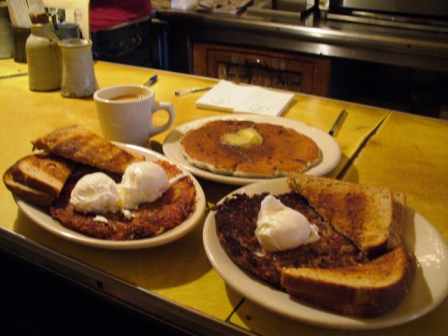
Al’s BreakfastI had earmarked visits to a few places I had been known to frequent back in the day.  Where better to start than breakfast?  A good day in the field or on the water involves a starting with a hearty breakfast.  So our first stop was Al’s Breakfast, a Minnesota icon, in the Dinkytown neighborhood of Minneapolis, just off the East Bank of the University of Minnesota campus.  Fourteen stools  on 10 feet of 14th Al’s Counter ShotAvenue real estate.  I’ve probably spent time on all 14 stools at one time or another during my years at the University of Minnesota.  Hey, it was on my way to class, and I’ve never been known to turn downAdam and Eve on a Raft the “perfectly poached egg” over hashbrowns.  This was my quest this day along with a couple rafts and links in the alley and a cup of joe (or a blonde with sand to be more exact).  My breakfast companion opted for a deadeye over dogfood and a couple of yummy whole wheat rafts.  Plus, we couldn’t The Last Breakfastturn down a short stack of blues to share.  Al’s version of diner slang Tipping, Russiadidn’t go to that extent on this day, but the soup jockey did use the dogfood and short blues references (the corned-beef hash and blueberry pancakes, respectively).  That, along with a drawing of “The Last Breakfast” that hangs behind the counter, prompted this diner lingo search

A trip to the Seven Corners area of the West Bank led to the discovery that the legendary Five Corners Saloon no longer stands as such, and is now something called the Nomad World Pub.  Disappointing – we did not stop.  Back in the day, we packed into the Five Corners weekly to dance the night away with the Spaceheaters, a Grateful Dead cover band, who were packed equally as tightly into the cubbyhole of the Five’s improvised stage.  There was also the weekly rendezvous down the street at The Cabooze with The Big Wu.  Weekly, back-to-back nights of jam bands and cuttin’ a rug – good times.

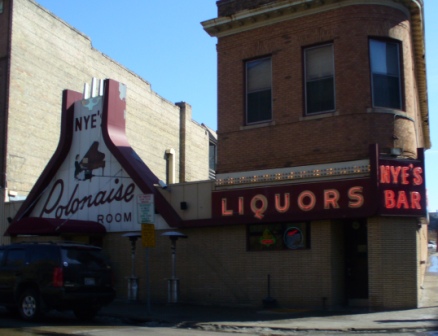
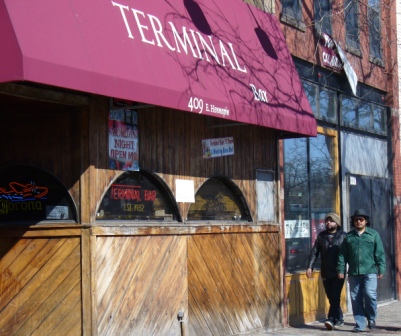
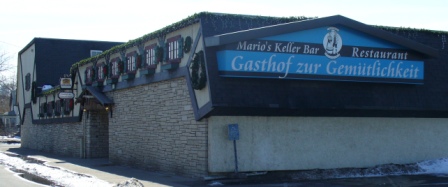
 Nye’s      The Terminal      The Gasthof

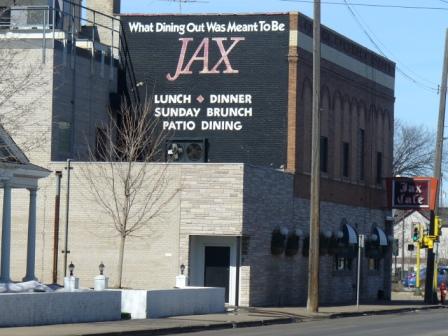
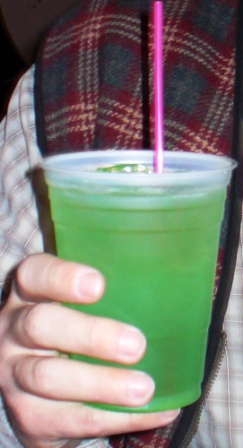
Taking a stroll through Nordeast Minneapolis we revisited some old favorites like Nye’s and The Terminal, where I was introduced to my first perfect pint of Guinness, and ran up past the Gasthof/Mario’s Keller Bar and Jax Cafe, truly one of the finest dining experiences in the city.  Ultimately we decided to stop in to Tony Jaros’ Rivergarden for a Summit and a Greenie.  So many good times – I was glad to see the rest of these were all still kickin’.

Jax Cafe      Tony Jaros’ Rivergarden      The Greenie

I did get a chance to stop by my old urban hunting grounds, an area in Dayton on the banks of the Mississippi across from Cloquet Island.  The massive oak tree I use to spend fall weekday evenings in after a day’s work was still holding its ground.  I’d dash out of work to beat rush hour traffic and the sunset to gain a weekday escape from the city life with bow in hand.  Unfortunately the city has now turned the area into a park, complete with overlooks, paved trails, park benches, and a parking lot.  The island whitetail refuge seems to be, for the most part, undisturbed, but how long can that last with Home Depot’s being built in the shadow of suburban farms.

Cloquet Island      Urban Hunting Grounds      Eggie’s My Way

I wrapped up the trip the same way it started, with a trip to a favorite old diner.  This time it was Eggie’s Cafe in Crystal (seen here as #9 – Al’s is #8).  I hadn’t been a regular at Eggie’s in at least a dozen years, when, while living in neighboring New Hope, Eggie’s Eggs Benedict My Way and a side of their famous American Fries became a staple part of my diet.  The My Way is Egg’s Benedict, substitute bacon and cream cheese for the ham, add an order of their specialty fries to sop up the extra hollandaise, and accompanied by a never-empty cup of joe — oh my — comfort food heaven!  The best part of this return trip, Carol, the same waitress that worked the counter when I was a regular a dozen years ago, was still there with a smile and a quick refill.  Carol remembered me as I placed my order and let a dozen years slip to a what seemed like, for a moment, a week.  She called for Ray as he appeared to schmooze with his patrons.  Ray Hawk, the second generation owner of Eggie’s, came around the counter to tell us a few stories and offer a handshake and a “thanks for coming back.”  Class.

Survived Midterms

So I must apologize for my hiatus!  The last two weeks have been a sleep-when-you-can, blur of the wikis and project proposals, freelance articles and query letters, the American Revolution, Hinduism, the Western, and Paradise Lost as I entered the first stage of midterm exams, papers, and projects.  I’m happy to report that I pulled through just in time for a personal reward of fish and chips, The Glenlivet scotch whiskey, and Guinness stout at Brigid’s Cross after my last midterm Friday.  Now I plan to use spring break as a chance to get a running start on the next two-thirds of the semester.

One of the projects I will be working on in the coming weeks is my project for Weblogs and Wikis, which will be a set of blogs spearheaded by the Liberty Pines Ranch Breaks.  I am in the midst of gathering the resources for this assignment and I will make more information available on this as I begin to develop the project.

In the meantime, I was able to get out for the better part of a day a couple weeks ago to meet a friend and pay a visit to one of my favorite places – Itasca State Park.  This gave me the opportunity to add some wintry pictures to my extensive Itasca photo album as I have never visited the park in winter.  Plus, I could use the excursion as an extra credit assignment for my U.S. History to 1877 class. Itasca has the distinction of being known as the jewel of the Minnesota State Park system and is home to the Mississippi River Headwaters, some of the most gorgeous forest in the North Woods, and numerous historical sites and places.

Itasca State Park 2.23.08.001 - East Arm Lake Itasca

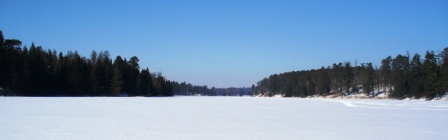
This is a north-facing view of the east arm of Lake Itascafrom just below Douglas Lodge, not far from the point where in 1832, Henry Rowe Schoolcraft led by his Ojibwe guide, Ozawindib, first saw the source of the Mississippi River.  The name “Itasca” was derived by borrowing from the Latin words for “truth” and “head.”

Itasca State Park 2.23.08.003 - Douglas Lodge

Historic Douglas Lodge was constructed between 1903-1905.  Originally called Itasca Park Lodge, it now bears the name of then Attorney General Wallace B. Douglas, who selected the building site overlooking the east arm of Lake Itasca.  The lodge was completed for a cost of $11,646.35.  In addition to the historic lodge, there are a variety of other facilities ranging from the Dormitory (1932) and the Clubhouse (1911), to the log cabins (1911) and the Fireplace Rooms (1937) to the Forest Inn (1938-1940).  Many of the facilities in the Douglas Lodge complex are listed on the National Register of Historic Places.

Itasca State Park 2.23.08.002 - Old Timer’s Cabin

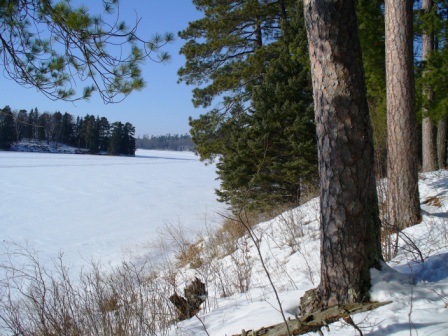
Looking west across the east arm, you can see the Old Timer’s Cabin, built in 1934 it was known as the “Honeymooner’s Cabin” to the Civilian Conservation Corps (CCC).  Located 1/4 mile down the Dr. Roberts Self-guided Nature Trail, it’s most memorable feature is the huge white pine used to construct its 4-log high walls.

Preachers Grove, named for a preachers convention that once camped there, holds a nearly 300 year-old stand of towering red pine and was produced when the seeds for these giant trees sprouted after a forest fire swept the region in 1714.

Itasca State Park 2.23.08.014 - Foot Bridge

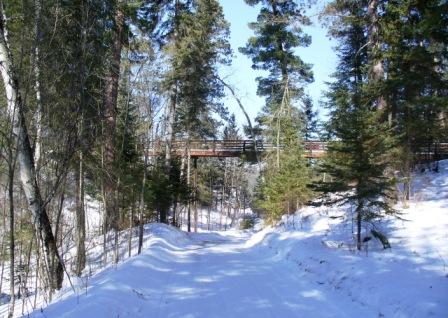
The foot bridge that spans the ravine between Douglas Lodge and the Clubhouse.

Itasca State Park 2.23.08.012 - South View on the East Arm

A south-facing shot further up the lake-side hiking trail along the east arm…

Itasca State Park 2.23.08.013 - North View on the East Arm

…and looking north from the same trail.

Itasca State Park 2.23.08.005 - Mary Gibbs Mississippi Headwaters Center

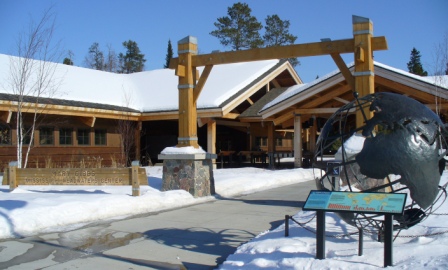
Since its dedication in 2005, the Mary Gibbs Mississippi Headwaters Center has been an informational and educational visitors center worthy of the Great River.  This complex and the equally new Jacob V. Brower Visitors Center near the east entrance of the park have greatly complimented the parks historical sites and buildings with beautiful architecture and historical, geographical, geological, and  environmental exhibits.

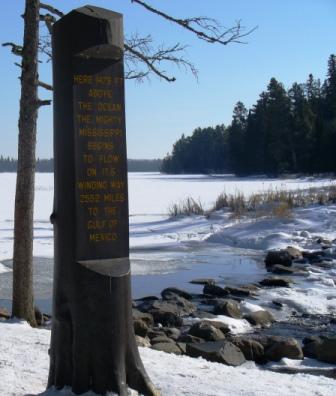
Itasca State Park 2.23.08.009 - 1475-2552

“Here 1,475 ft. above the ocean the mighty Mississippi begins to flow on it’s winding way 2,552 miles to the Gulf of Mexico.”

Views of the Headwaters…

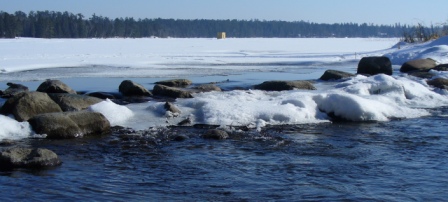
Itasca State Park 2.23.08.006 - Mississippi Headwaters

Itasca State Park 2.23.08.007 - Mississippi Headwaters II

Itasca State Park 2.23.08.008 - Mississippi Headwaters III

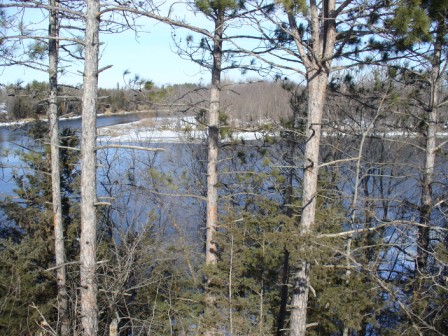
…yes, that’s a ice-fishing house just a couple hundred yards into the lake.

Itasca State Park 2.23.08.011 - Infant Mississippi

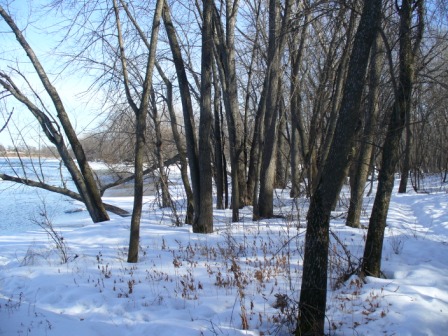
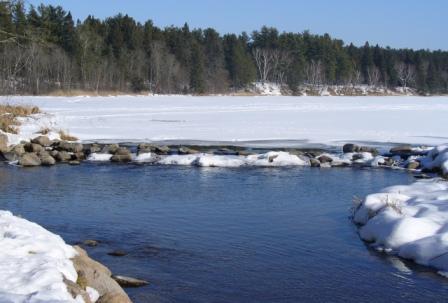
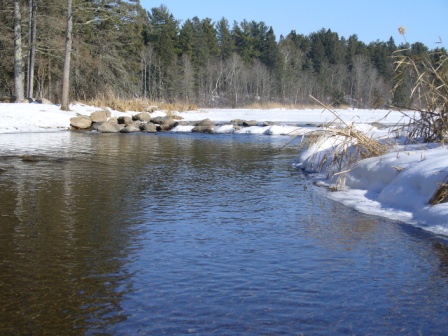
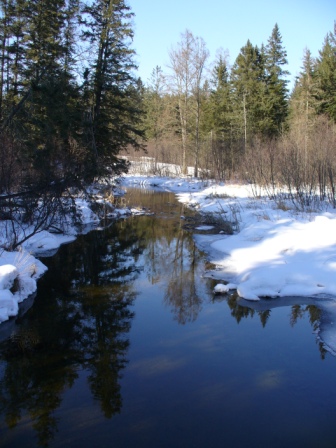
The infant Mississippi, flowing north before turning south, a couple hundred yards into its voyage.

Itasca State Park 2.223.08.010 - Old Northwest Territory

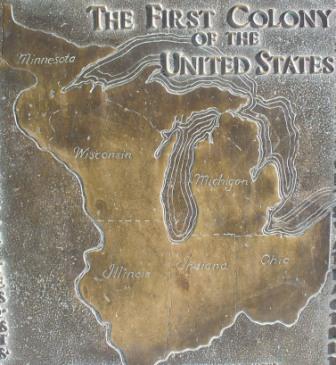
The Old Northwest Territory – A stone tablet at the Headwaters reads “Herein, under the Ordinance of 1787, began the westward expansion of this nation – the American Bill of Rights first nationally recognized – human slavery prohibited – primogeniture abolished – and the great new principle of colonies becoming equal in rights with parent states was established — Itasca Lake source of the Mississippi River, discovered by Henry R. Schoolcraft in 1832.  The Treaty of Paris, 1783, provided that the United States’ northwest boundary should extend from the Northwest Angle of Lake of the Woods to the Mississippi River.  Itasca was on this boundary.”