Thoughts on “Mixed Messages”

Mixed MessagesChemicals!  Chemicals everywhere!

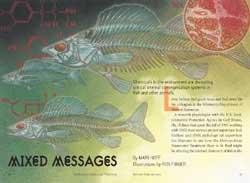
The latest article comment reading assignment in People and the Environment was the feature from the January-February 2002 issue of the Minnesota Conservation Volunteer“Mixed Messages” by Mary Hoff.

The article details the increasing discovery of endocrine disruptorsin the environment and their relation to anomalies of nature.  In particular, this article revealed the presence of vitellogenin, a protein female fish produce as part of egg-making, in Mississippi River malecarp and walleye.  The fish tested were pulled from waters downstream of the Metropolitan Wastewater Treatment Plant effluent in St. Paul.

“Nobody blinked at the carp data, but when we found vitellogenin in male walleye, it was on the front page of the Star Tribune,”  explains Leroy Folmar, the research physiologist with the U.S. Environmental Protection Agency who conducted the study highlighted by Hoff’s article.

Well, of course, a carp is – well – a carp, an overgrown minnow, a rough fish, a Eurasian invader introduced to North American waters by humans long ago.  But the walleye is the Minnesota state fish, and, for its beauty and table fare, the prize catch and most sought after game fish in the land of 10,000 lakes.

The extent of the affects, the damages to the global ecosystem, of endocrine disruptors are largely unknown, but increased studies are producing more prevalent evidence.  The process of recovery is slow because of the daunting task of identifying the vast array of individual chemical culprits and the equally vast array of abnormalities they produce.  Then there is the “harmless” chemicals that bond with other seemingly harmless chemicals to form yet another endocrine disruptor.

A web search turned up a 2005 Institute for Environment and Health compilation of published lists of Chemicals Purported to be Endocrine Disruptors – it’s 91 pages long!

What are we putting into our environment?  Why are we only concerned to a sense of urgency when it threatens human life or a desirable part of human life, if at all?  Our environment is trying to tell us something – we’re poisoning our Earth.

Thoughts on “Thinking Like a Mountain”

Thinking Like a MountainRecently, while comparing educational pursuits with another returning college student who is seeking teaching licensure in literature, I conveyed my aspirations of redirecting my career in the outdoors and environmental industry beyond a Bachelor of Fine Arts degree in Creative and Professional Writing and a Bachelor of Science degree in History at Bemidji State University.  Aspirations that include pursuing a writing and educating career in some aspect of the outdoors and environment in order to fulfill my personal ambition to “leave something behind” when I am no longer a physical presence in this world, something to show that I have done my part to contribute to the betterment of society.

By this, the co-ed asked if my inspirations included Aldo Leopold.  Embarrassed to admit that I was only slightly familiar with the name and what it stood for, not the man and his work, I deflected his inquisition to what my experience included, the work I was doing now, and where I hoped that would lead me.

A recent reading assignment of the essay “Thinking Like a Mountain” by Aldo Leopold for my People and the Environment course provided the opportunity to research and the life long work of Aldo Leopold, the forester, ecologist, conservationist, environmentalist, philosopher, educator, writer, fisherman, hunter, and outdoor enthusiast.

Leopold is considered by many to be the father of wildlife management and of the United States’ wilderness system.  His life’s work was influential in the development of modern environmental ethics and in the movement for wilderness preservation.  His introduction at The Aldo Leopold Foundation website begins with this quote:

“As a society, we are just now beginning to realize the depth of Leopold’s work and thinking.”

– Mike Dombeck, Chief Emeritus U.S. Forest Service, Professor of Global Environmental Management UW-Stevens Point, UW System Fellow of Global Conservation

In Leopold’s greatest written work, and the culmination of his life’s work, A Sand County Almanac, completed just prior to his death in 1948 and published postmortem, he wrote “The Land Ethic”, a chapter where he lays out his conservation plan for the human culture.  Under the Community Concept of this land ethic, Leopold wrote:

The land ethic simply enlarges the boundaries of the community to include soils, waters, plants, and animals, or collectively: the land.

…a land ethic changes the role of Homo sapiens from conqueror of the land-community to plain member and citizen of it. It implies respect for his fellow-members, and also respect for the community as such.

In “Thinking Like a Mountain,” we are offered a view of a precursor to Leopold’s land ethic.  A profound moment in his life when he realizes the value of a community that includes the land, and the tragic consequences that occur when any component of that community is severed, lost, or no longer permitted to exist. 

Leopold demonstrates through his own experience the recognition of changing mindset.  The wolf as a member of the land, the natural world, must persist for the good of the overall quality of life on this planet.  The example of his killing the wolf and ultimately his realization of what has become of the wilderness without it shares the knowledge learned through the act of recklessness and disregard for the delicate balance in the ecosystem.

In short, he is warning society not to duplicate this reckless disregard on a global scale.  Our culture owes an ethical responsibility to the place that gives us life.

Ditches

DitchesDo you think counties should be spending money on mowing ditches?

I found the following detail of the Minnesota statute pertaining to mowing ditches at the Minnesota State Legislature website, or more specifically at the Minnesota Office of the Revisor of Statutes website:

2007 Minnesota Statutes

  • 160.232 MOWING DITCHES OUTSIDE CITIES.
    (a) To provide enhanced roadside habitat for nesting birds and other small wildlife, road
    authorities may not mow or till the right-of-way of a highway located outside of a home rule
    charter or statutory city except as allowed in this section and section 160.23.
    (b) On any highway, the first eight feet away from the road surface, or shoulder if one
    exists, may be mowed at any time.
    (c) An entire right-of-way may be mowed after July 31. From August 31 to the following
    July 31, the entire right-of-way may only be mowed if necessary for safety reasons, but may not
    be mowed to a height of less than 12 inches.
    (d) A right-of-way may be mowed as necessary to maintain sight distance for safety and
    may be mowed at other times under rules of the commissioner, or by ordinance of a local road
    authority not conflicting with the rules of the commissioner.
    (e) A right-of-way may be mowed, burned, or tilled to prepare the right-of-way for the
    establishment of permanent vegetative cover or for prairie vegetation management.
    (f) When feasible, road authorities are encouraged to utilize low maintenance, native
    vegetation that reduces the need to mow, provides wildlife habitat, and maintains public safety.
    (g) The commissioner of natural resources shall cooperate with the commissioner of
    transportation to provide enhanced roadside habitat for nesting birds and other small wildlife.

I agreed with most of this Minnesota statute, then I found the information at the Office of Environmental Services website for the Integrated Roadside Vegetation Management (IRVM) process

IRVM is a decision-making and quality management process for maintaining roadside vegetation that integrated the following:

  • the needs of local communities and highway users
  • the knowledge of plant ecology and natural processes
  • design, construction, and maintenance considerations
  • monitoring and evaluation procedures
  • government statutes and regulations
  • technology

…with cultural, biological, mechanical, and chemical pest control methods to economically manage roadsides for safety plus environmental and visual quality (NVRMA, 1997).

First of all, you can be sure that county ditch mowers run wild during the month of August if not before that every year in this state.  It happens nearly every year across the front of my property; every once in a while my ditch, the one you see pictured above, eludes the razor’s edge.  If a ditch being mowed would resolve a safety issue I could understand that, but I believe in most cases it falls on those last two words in the IRVM statement…

“visual quality.”

Mother Culture has beaten into our minds that a freshly mowed expanse of grass is the only acceptable form of appearance for that piece of real estate, which in fact, by the statutes own words is habitat for wildlife and native vegetation.  What’s wrong with the wildflowers that bloom in my ditch each summer and the beauty of the grasses waving in the wind?  Isn’t that “visual quality?”

Then there is the mention of “chemical pest control methods.”  Are these really necessary?  Where do those chemicals end up?  In the water supply?  In the lakes I fish?  Not to mention the fuel consumption and emissions produced just to maintain this unjustified taxpayer expense of visual quality.

Wouldn’t the first eight feet mentioned in the statute, if that is even necessary, be enough to solve the safety issue at all times?  Don’t come around here mowing my ditch.  We don’t need your habitat destruction in the guise of management.  There’s already plenty of it going on in this world.