Live and Let Live

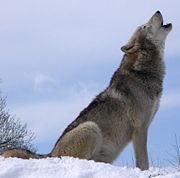
Howling WolfDo you think humans should decide whether or not another species lives or dies?

I would think that the answer to this question to be an obvious no.  That is, if we are talking about simply, as if this could be a simple discussion, the existence of a species, period.  If a species were to fade into extinction, it should only be at the hands of an evolutionary demise.  I believe all humans have some basic type of understanding about the importance of each individual species’ role in its habitat or environment, our environment.

Should we knowingly disregard the extermination of any species at the hands of human society?  NO

Should we continue to study the effects of human society on the global environment to prevent any species’ extinction, and work to aid the recovery of any endangered species?  YES

However, the slant of this discussion where the line blurs and the black and white blends to gray is the debate that ensues when a species is no longer a welcome inhabitant of a geographical space, or is perceived to be an alien intruder in that space.

The reality is civilization’s encroachment on the unique habitats throughout the world causes the confrontation between humans and the most visible threatened species; the large mammals, birds, fish, reptiles, and trees.  It is a debate that began with the advent of the agricultural age, when human proliferation began to threaten the surrounding and coexisting species.  Whether directly affected by the urbanization caused by the rampant, relatively recent, explosion in the human population, or disrupted by the blatant misuse or mistreatment of our natural resources by the increasing agricultural and economical demands imposed on our natural capital, the first and biggest losers will always most likely be the species that require the most space in comparison to our own demands.  In competition with the human species, they don’t stand a chance.

But what about the invasive species of the world’s unique habitats?  Are these species invasive because we deem them to be a threat to the invaded ecosystem and our way of life, or is it part of the evolutionary cycle?  Certainly Eurasian watermilfoil, sea lamprey, zebra mussels, and Asian carp for example are negative influences to the delicate balance in the ecosystems of Minnesota’s lakes and rivers.  But I would argue that, while undesirable, these intruders still deserve the right to coexist with humans because of their intrinsic, and possibly yet to be discovered, value.

Also, there is this question, are we the invaders in every ecosystem on the planet?

Check out the following sites to learn more about invasive species:

A Bike Trip

Thursday’s bike trip from campus to the participating downtown businesses started from home to campus for me.  But my preparation for this little group excursion actually started over a week ago.  Since moving to Bemidji, my mountain bike has been one of those toys that has taken a back seat to other toys and activities.  When I found out there was a bike trip planned for one of our field trips for People and the Environment, the time came for a good reason to pull the bike from its suspended animation in the rafters of the garage, blow the dust off, take it in for a tune-up, and shake the rust off my butt.

The bike shop said two weeks turn around time as they were inundated with projects from patrons who apparently had the same idea I did with the long awaited hint of summer making an appearance.  The only problem was whether they could find the parts to repair what 10 years of hard riding and five years of sitting on the shelf had inflicted.  She needed a good lube, brake adjustments, gear shifters repaired or replaced, and, as I found out after the fact, new tires and tubes; both the tires had deteriorated to the point where they blew in the shop after I dropped it off.  My apologies to the folks at the Home Place Bike & Ski shop for that one!

I didn’t know if I would have it back in time for the big ride, but to my surprise there was a voicemail Monday saying it was ready to go.  I immediately headed down for pick up, hoping to get as much riding in as possible before Thursday in order to get, well, certain parts of the body use to it again.  One more piece of new equipment would be vital to this – a new seat to replace the worn out, cushionless original.  So, $120 later, my Giant ATX 760 had new rubber, a new seat, properly functioning brakes, and working gear shifters.  Not bad, considering the alternative was a MegaLowMart special for a similar price or a comparable Trek replacement for for over five times the cost.

Now, I just needed to get the old muscles reacquainted with the bike.  The first few strides told me the worry would not be my gluteus maximus, but my quads.  Apparently, parts of those muscles had forgotten what it was like to ride a bike.  Ol’ Jake remembered the days when we used to tackle the trails of the Three Rivers Park District, as he headed down the road beside me – one sorry old butt after another.  Well, the bike rode like new again, the quads were a surprise, but I’m happy to report the new seat worked great.  It felt good to be back on that bike again.

Thursday morning I timed the commute from my place to Deputy Hall so I could begin implementing a bike commute for summer and fall classes – 16 minutes flat without pushing it really, well, at all.  I had no idea how long it would take me to cover the few miles to campus – I was the first one to arrive by about 15 minutes!  I suppose there was about 40 of us on bikes, students and faculty alike, and we finally were blessed with a gorgeous day in this rain-filled spring to enjoy the ride.

There would be five businesses we would be visiting in the downtown area as part of the reacquaintance with this mode of transportation:

At Wild Hare, co-owner Reed spoke with us about the integrity of the benefits of organic agriculture and fair trade, such as a fresher, higher quality product produced with little to no hormones, pesticides, and herbicides by producers being paid a fair price that covers the costs of sustainable production and living in order to establish balance between industrialized and non-industrialized countries involved in international trade.  He talked about how the produce they use in their cuisine have a naturally better flavor than the genetically engineered “cardboard” products you’ll find from corporate farms.  Their “About Us” introduction on their website states:

We envision a space where people of all walks of life can come together and share in good food and conversation, get to know their neighbors and break down social barriers.

At Harmony Foods, Lisa introduced us the benefits of local produce versus products shipped in from all corners of the world giving the consumer a better quality, fresher product that has ripened on the vine or grazed natural grasses rather than the lesser quality, truck-ripened, hormone-injected, whatevercide-laced, growth enhanced, vitamin and nutrient free products you’ll find at the any nationwide MegaLowMart.  She informed us of the ability for their consumer to buy bulk products by ordering or bringing in their own receptacle to the store which saves the all parties involved, from producer to consumer, the extra costs of packaging and advertising.  She also spoke of the benefits of fair trade, their community-based service niche, and, although shelf price is shelf price, for a $60 lifetime membership, members can share in profits and benefit from price discounts on bulk items.

At Pawn USA, Goodwill, and the Twice But Nice consignment clothiers, each store explained how their business worked from the pawn or sell option at Pawn USA, to the tax-deductible donation option at Goodwill, to the percentage based profit if sold option at Twice But Nice.  Overall, the message portrayed by these businesses is one of reducing by reusing when it comes to clothing and “stuff,” and, with my mother and sisters’ garage sale and my own eBay success, I can attest to the fact there seems to be quite a market for fraction-of-the-cost-of-new, second-hand goods.  In affect a second hand purchase preserves the amount of our natural capital it would take to produce the same item, albeit new, but for an inflated price tag of the slightly used.

OK, OK, I agree with most of the stuff these businesses are pitching, but I draw the line at clothes someone else has lived in – but that’s just me and my opinion.  I’ll just have to make up for that part of my ecological footprint somewhere else.  I think the thing that left the biggest impression on me was the realization that Goodwill uses the money from their profits to help create training programs for people with disabilities.  I didn’t know this and it will help me the next time I am reluctant to give away some of my “stuff” in the form of a tax-deductible donation.

I was most intrigued by the introduction to Wild Hare and Harmony Foods Co-op.  The convenience of shopping the MegaLowMart has robbed me of the quality produce local, organic agriculture can provide.  I had shopped Harmony Foods prior to this encounter but I never really understood the value of the co-op and the products they provide.  I plan to shop there more frequently in the future.  Wild Hare is a no-brainer for me as I am always on the lookout for a new, great place when it comes to dining – any type of dining.  I will be back often.

However, I think the bike trip for me was about the bike trip itself.  The bike had spent too many summers hanging from the roof of the garage and I have spent too much time behind the wheel of the truck.  It’s time to get right back on that bike.

Minnesota Conservation Volunteer

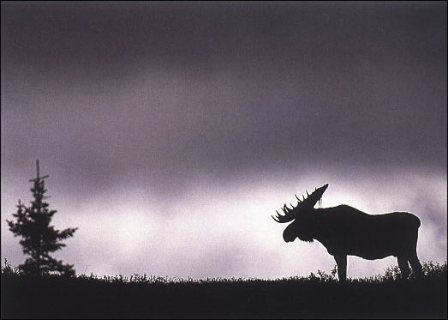
The Disappearing Majestic MooseThe Minnesota Conservation Volunteer is the magazine of the Minnesota Department of Natural Resources.  A subscription to the magazine is free to Minnesota residents, and is truly a wonderful publication filled with the flora and fauna of the Minnesota landscape.  However, I read the majority of the articles online because of the website’s fantastic online archive.

I chose the hunting story “Wilderness Moose Hunt” by Chris Niskanen from the magazine’s September-October 2006 issue for our Minnesota Conservation Volunteer article comment assignment because I am a hunter and an outdoorsman.  But the struggle of the Minnesota moose herd is a sign of our changing environment as well, and easily relates to the topics we have been discussing in People and the Environment.

I first came upon this article a few months ago while researching information for a post I made concerning the Minnesota bear and moose hunting license lotteries and seasons.  That post I made on April 6 has become the most frequently searched and viewed post on this website.  Echoing this statistic found in Niskanen’s article:

Moose hunting is enormously popular in Minnesota. In 2005 the DNR received applications from 3,060 parties of two to four hunters for 284 moose tags in 30 zones.

Niskanen explains the romanticism with a hunting story that takes place in the Boundary Waters Canoe Area Wilderness (BWCAW):

Minnesota is among only a dozen states where moose are hunted and among fewer where the experience can demand wilderness canoeing and backcountry woods skills—the makings of an exquisitely primitive hunt. Only Minnesota residents can apply for and win the once-in-a-lifetime tag….

…Moose are North America’s largest deer species. Minnesota specimens, known as the Canada subspecies, can weigh up to 1,300 pounds. For their size alone, they capture the imaginations of hunters, present and past.

The range of the moose (Alces alces) still includes the habitat of the North Woods of Minnesota, although in recent years several factors have contributed to a steady, excessively high, non-hunting mortality rate.  This has led to the closure of the moose hunt in Minnesota’s Northwest region where numbers have fallen below a safe huntable surplus, and has recently become a bull moose-only-hunt in the state’s Northeast Arrowhead region.  The following excerpt from my April 6 post as well as the links to the articles I referenced explains the battle the moose is fighting:

Researchers are feverishly working to find the reasons why the population has seen such a drastic decline.  Some theories suggest that warming climates leading to heat stress, encroaching exploding deer populations, and parasites like liver fluke, brainworm, and winter ticks as well as predators and habitat loss are the contributors to the decline in numbers, but so far a hard and fast reason has eluded researchers.  It may be a combination of these reasons, so researchers are intensely studying the herd looking for clues that will suggest the cause and possibly ways to help the moose fight what is threatening the herd.  Declining moose numbers are not unique to Minnesota.  When I searched the web for information on some of these threats, I found numerous sites, studies and articles that have documented some of the research that has been done all over moose’s North American range.  Below you will find links to some of the best of those findings.

In reading the above selected articles, you’ll find that heat stress is not the only reason why the moose is in decline, but a warmer climate is definitely affecting the range where these majestic animals can exist.  Factoring in the ever encroaching human species as a contributor to habitat loss and introduction of disease via an exploding white-tail deer population gives a bleak outlook to the future of the moose herd in Minnesota.

I remember when moose crossing signs stood along the roadside of Highway 2 west of Bemidji.  Those signs are no longer there as the moose population in Northwest Minnesota has fallen to an estimated 84 as of 2007.  However, I saw a sign to give me hope while returning from a recent fishing trip to Upper Red Lake.  As I drove home through the bogs surrounding the lake, deep in thought remembering my day of fishing, something large came hurdling out of the bush on the right side of the road.  I didn’t immediately recognize the potential obstacle, but I knew that what I was seeing out of the corner of my eye was large enough to impede my safe passage down the highway.  I instinctively swerved into the empty oncoming lane in order to give this unexpected traffic a wide berth, and as I crossed its intended path it pulled up to a stop.  At the moment of realization that the danger was gone, I was amazed to set my eyes on the source of my sudden deviation in course, a cow moose with her newly born calf in tow.

I have seen moose in the wild before on hunting and fishing trips to western states and Canada as well as a particularly close encounter of my own in the Boundary Waters some years ago with a cow moose and her two calves.  However, in the light of the current situation of the species here in the region I call home, this sighting was certainly a wonderful surprise.  My thoughts along the road home of the day of fishing quickly changed to guesses at where this family was coming from and where they were headed at the moment of our chance meeting.

I’m hoping a cool spring and summer will help that mother nurture her calf to a fortuitous start in life.  I hope to one day have an amazing story to write about my own Minnesota moose hunt, but I hope the massive bull of my dreams will not be a ghost story of a species lost.